
$0 Fixes
Your Ear Is Not a Tiny Mining Operation
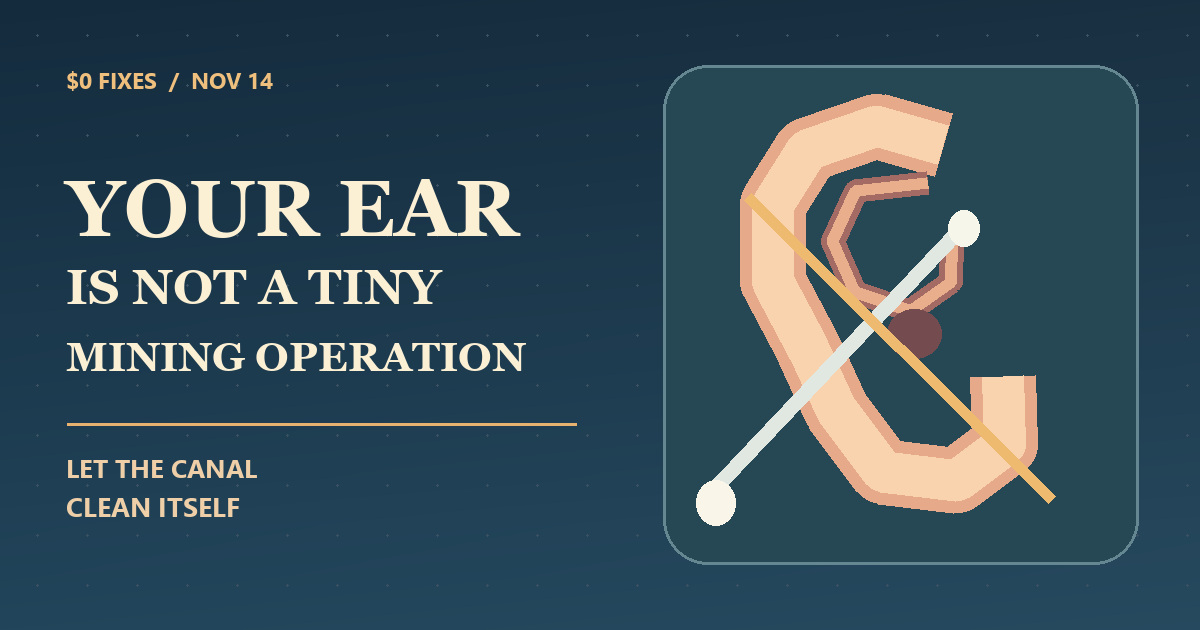
That cotton swab may bring out a little wax while pushing more of it inward. The free first step for a comfortable ear is often to leave the canal alone.
Sonny Saggar, MD · 2026-11-14
The Claim
There are household rituals so deeply established that their own packaging has given up arguing. The cotton swab, an excellent object for some cleaning jobs, is not an invitation to tunnel into the ear canal. Earwax is not proof of neglect. It helps trap debris and protect sensitive skin, and in most people it gradually moves outward by itself. [1] [2]
For someone without symptoms, the American Academy of Otolaryngology guideline recommends against routinely treating wax that is not obstructing a necessary examination. NICE advises adults not to insert cotton buds or small objects into the canal, because they can push wax deeper and injure the canal or eardrum. That costs precisely nothing to stop doing. [1] [3]
Why The Ear Has Its Own Cleaning Department
The external ear canal is not a drainpipe needing a weekly plumber. Its protective wax gradually migrates outward. Repeated prodding can compact it, scratch delicate skin or, with an unlucky movement, damage the eardrum. Removing visible material from a swab is not evidence that the overall cleaning has helped. [1] [2]
The problem changes when wax is truly impacted: hearing may become muffled, the ear may feel full, tinnitus may occur, or an examiner may be unable to see the eardrum. That is a reason to check what is wrong, not evidence that everyone should dig out every bit of wax. [1] [4]
What The Studies Can And Cannot Tell Us
A Cochrane review assessed 10 trials with 623 participants examining drops used for obstructing or impacted wax. It found low-quality evidence that drops may help some patients, but insufficient high-quality evidence to establish that one active product beats another or plain water or saline. These trials studied treatment of blockage, not the supposed benefit of routine cotton-swab excavation in normal ears. [5]
The best-supported $0 intervention here is avoidance of a potentially harmful habit. It is not a claim that doing nothing cures all hearing loss or that earwax never needs removal.
The Strongest Objection
"But the swab feels effective, and I can see the result." Of course. The ear is real, the wax is real, and a little material may be visible on the tip. The claim under examination is whether inserting an object helps the canal remain healthy, not whether cotton can pick up something yellow. The professional guidance advises against the behavior because the possible injury and impaction matter more than the pleasing evidence on the swab. [1] [3]
The Exceptions
A person with impaired hearing, pain, drainage, ear fullness, tinnitus or troublesome wax deserves assessment, particularly if symptoms are new or one-sided. Hearing-aid users and people who cannot reliably report symptoms may need periodic examination. The correct treatment for confirmed impaction may involve clinician-recommended softening drops, irrigation or professional removal. [1] [4]
Do not attempt home irrigation or drops without specialist guidance if you might have a perforated eardrum, ear tubes, previous ear surgery, active infection or other complicating ear conditions. Diabetes, immunosuppression and anticoagulant use can also change the assessment. [1] [2]
Seek prompt medical assessment for sudden hearing loss, severe pain, bleeding, discharge, marked dizziness or neurologic symptoms. Sudden hearing loss must not be dismissed as "probably wax." [1] [6]
What To Do For $0
Stop putting cotton swabs, hairpins, fingers or camera-ended gadgets into the ear canal. Clean only the visible outer ear gently with a washcloth when washing. If you feel blocked or hear less well, arrange an examination rather than trying to win a domestic excavation competition. [2] [3]
If impacted wax is diagnosed, follow individualized advice for safe removal. The free fix is avoiding unnecessary probing; it does not replace appropriate treatment for a genuine obstruction.
What Would Change The Verdict
Good comparative research demonstrating that routine canal probing improves hearing or reduces impaction without additional injury would warrant reconsideration. Until then, the guidelines and the ear's own biology make the same sensible recommendation: leave the tunnel alone.
Sources and receipts
- [1] Schwartz SR et al. Clinical Practice Guideline (Update): Earwax (Cerumen Impaction). Otolaryngology Head and Neck Surgery. 2017. — Source cited in the reviewed article
- [2] MedlinePlus Medical Encyclopedia. Ear wax. Reviewed April 29, 2026. — Source cited in the reviewed article
- [3] NICE. Hearing Loss in Adults: Assessment and Management, Recommendation 1.2.5 on Earwax. — Source cited in the reviewed article
- [4] NHS inform. Earwax Build-up. Updated October 2026. — Source cited in the reviewed article
- [5] Aaron K et al. Ear drops for the removal of ear wax. Cochrane Database of Systematic Reviews. 2018. — Source cited in the reviewed article
- [6] MedlinePlus Medical Encyclopedia. Ear emergencies. — Source cited in the reviewed article
From the same professional problem-solving perspective: YouTube · Spotify · Substack.